On 22 January 1879, 150 British
troops fought 4,000 Zulu warriors at Rorke’s Drift. To Victorian readers, the
stand became one of the supreme symbols of imperial heroism, though Dominic
Sandbook explains how the battle is still clad in the myths of empire…
This article first appeared in the
January 2012 issue of BBC History Magazine
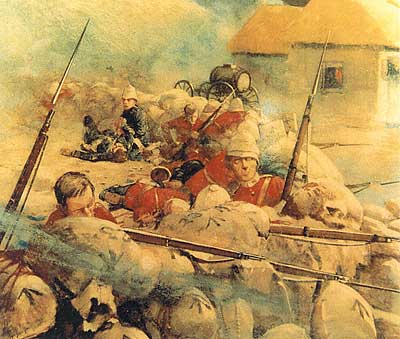
Alphonse de Neuville’s 1880 painting
The Defence of Rorke’s Drift.
Shortly before four o’clock in the
sweltering hot afternoon of 22 January 1879, a small group of British and
colonial troops, packed into a mission station on the border of Natal and the
Zulu Kingdom, had the news they dreaded. Earlier that day, a British column,
advancing into Zululand, had been annihilated at Isandlwana. Now there was
nothing between the enraged Zulus and the little mission station at Rorke’s
Drift, which had been turned into a makeshift hospital for the purposes of the
war.
Some officers wanted to pull out and
ride for safety, but Assistant Commissary James Dalton argued that they were
bound to be slowed down by the wagons of sick and wounded, which meant the
Zulus would inevitably overtake and destroy them. Instead, Dalton told his men
to put up makeshift barricades of biscuit boxes and corn sacks. “Now,” he said
grimly, “we must make a defence”.

So they waited. And at last, as the
first specks appeared on the horizon, one of the look-outs yelled the famous
words: “Here they come, black as hell and thick as grass!”
To modern ears the line may sound shocking, reminding
us that the British were, after all, invaders. To the men at
Rorke’s Drift, however, those words must have sounded terrifying. Barely 150
British and colonial troops, many of them frightened and exhausted, were packed
into the mission station, their red uniforms stained with dust and sweat.
Surrounding them were an estimated 4,000 Zulu warriors, many armed with rifles
as well as their short, lethal assegais. Rarely had any British force found
itself up against such overwhelming odds.
What happened next became one of the
most celebrated struggles in the history of the empire. All night the battle
raged, much of it concentrated around the low hospital building. Time and again
the Zulus charged, repelled only by volleys of lethal rifle fire and bloody
bayonet work.
“Such a heavy fire was sent along
the front of the hospital that, although scores of Zulus jumped over the mealie
bags to get into the building, nearly every man perished in that fatal leap,”
recalled one British defender. Another, Colour Sergeant Bourne, could not
disguise his admiration for his opponents’ courage. “To show their fearlessness
and their contempt for the redcoats,” he recalled, the Zulus “tried to leap the
parapet, and at times seized our bayonets, only to be shot down. Looking back,
one cannot but admire their fanatical bravery.”
Slowly but surely, weight of numbers
began to tell. Room by room the attackers advanced through the hospital, the
British desperately pulling back, dragging terrified patients with them. At one
stage the defenders were forced to hold off the Zulus through a narrow door,
while Privates John Williams and Henry Hook earned Victoria Crosses for their
bravery in saving eight patients under fierce Zulu fire.
By ten o’clock that night the
hospital and the cattle kraal had been abandoned, and the defenders were packed
into
a little bastion around the
storehouse. The British had fought for ten hours; most were wounded. But by now
the Zulus were themselves losing heart – and they were running out of
ammunition.
At two in the morning their attacks
began to slacken; by
four
o’clock, even the volleys of gunfire were dying down. And when dawn broke at
last, the British were astonished to see that the Zulus had gone. They left the
field littered with their dead and wounded. All in all, they had lost at least
350 men, to the defenders’ 17.
Rorke’s Drift became one of the
supreme symbols of imperial heroism. To Victorian readers, the image of a
handful of plucky British troops holding off thousands of Zulus was an
inspirational lesson in courage and self-sacrifice. Some 50,000 Londoners
bought tickets to see Alphonse de Neuville’s giant canvas 'The Defence of
Rorke’s Drift' (pictured), while Queen Victoria paid a large sum for Lady
Butler’s painting on the same theme.
Above all, the battle was
immortalised in the classic film Zulu (1964), starring Stanley Baker and
Michael Caine. As so often, the film played fast and loose with the facts: the
British never sang 'Men of Harlech'; the Zulus never saluted them with a song
praising their bravery; and the film fails to show the British executing Zulu
prisoners after the battle. Almost a century on, the myths of empire died hard.
Dominic Sandbrook’s is the author of is State of
Emergency: The Way We Were: Britain, 1970–1974 (Allen Lane). He is a frequent
guest on Radio 4’s Saturday Review.