Welcome

Welcome
John William Tuohy lives in Washington DC

Today's words


 The verb debilitate (and its adjective form debilitating) comes from the Latin word for "weak," debilis.

 Winsome comes from Old English wynn, meaning "joy" or "pleasure," which was altered in spelling to win (with the same meaning). That win is obsolete and is unrelated to today's win—referring to victory and coming from Old English winnan, "to struggle, suffer, or acquire." The adjective winning, meaning "tending to please or delight," as in "a winning smile" or "winning ways," is believed to be from the victorious win.

 Cherub From Latin cherubim, from Greek kheroubin, from Hebrew kerubim. Ultimately from the Semitic root krb (to praise).

The plural is cherubs or cherubim. Cherubim are the second highest order of angels.

The Order of Angels

angels

archangels

principalities

powers

virtues

dominions

thrones

cherubim

seraphim

 Sanguine is the name of one of the temperaments that ancient and medieval scholars believed was caused by an abundance of one of the four humors. It comes from sanguineus—Latin for "of or relating to blood" or "bloody"—and over centuries has had meanings ranging from "bloodthirsty" and "bloodred" to "confidently optimistic."


 Euphemism comes from Greek eúphēmos, which means "uttering sounds of good omen," "fair-sounding," or "auspicious." The first part of that root is the prefix eu-, meaning "good."  The second part is phēmos, a Greek word for "speech."


Gloss, referring to a brief explanation, comes from Greek glôssa, meaning "tongue," "language," or "obscure word." There is also the familiar phrase gloss over, meaning "to deal with (something) too lightly or not at all." That gloss is related to Germanic glosen, "to glow or shine," and comes from the noun gloss, which in English can refer to a shine on a surface or to a superficial attractiveness that is easily dismissed.

 Stir-crazy originated as a word to describe a prisoner who became distraught after prolonged confinement. Stir is a 19th-century slang word for "prison" that some word historians have suspected to be from Romani stariben, of the same meaning. But a convincing argument of that origin has yet been made. Today, stir-crazy describes any person who has become restless, agitated, or anxious from being or feeling entrapped in some place.


No, Charles, no.


And I wouldn't have it any other way.


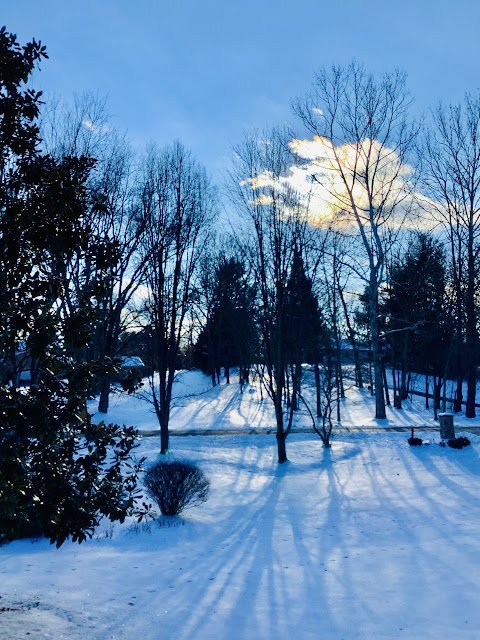
Photos I took from the front door because it was to early and too cold to go outside.


My front porch this morning


Julia Ward Howe


Julia Ward Howe, 1909, poet and author, best known for writing “The Battle Hymn of the Republic.”

The political correct who strive so hard to rewrite history had pretty much reduced her to a right wing, hyper religious zealot. Howe (May 27, 1819 – October 17, 1910) was a poet and author who was also an advocate for abolitionism and a social activist, particularly for women's suffrage.

She was inspired to write "The Battle Hymn of the Republic" after she and her husband visited Washington, D.C., and met Abraham Lincoln at the White House in November 1861. During the trip, her friend James Freeman Clarke suggested she write new words to the song "John Brown's Body", which she did on November 19.

The song was set to William Steffe's already-existing music and Howe's version was first published in the Atlantic Monthly in February 1862. It quickly became one of the most popular songs of the Union during the American Civil War.

She produced eleven issues of the literary magazine, Northern Lights, in 1867. After the war she focused her activities on the causes of pacifism and women's suffrage. She became active in reform and helped found the New England Women's Club and the New England Woman Suffrage Association.

Howe died of pneumonia October 17, 1910, at her Portsmouth home, Oak Glen at the age of 91. She is buried in the Mount Auburn Cemetery in Cambridge, Massachusetts. Approximately 4,000 people turned out in the rain to sing "Battle Hymn of the Republic" as a sign of respect.

After her death, her children collaborated on a biography, published in 1916. It won the Pulitzer Prize for Biography.

First published version of The Battle Hymn of the Republic

Mine eyes have seen the glory of the coming of the Lord;

He is trampling out the vintage where the grapes of wrath are stored;

He hath loosed the fateful lightning of His terrible swift sword:

His truth is marching on.

(Chorus)

Glory, Glory, hallelujah!

Glory, glory, hallelujah!

Glory, glory, hallelujah!

His truth is marching on.

I have seen Him in the watch-fires of a hundred circling camps,

They have builded Him an altar in the evening dews and damps;

I can read His righteous sentence by the dim and flaring lamps:

His day is marching on.

(Chorus)

Glory, glory, hallelujah!

Glory, glory, hallelujah!

Glory, glory, hallelujah!

His truth is marching on.

I have read a fiery gospel writ in burnished rows of steel:

"As ye deal with my contemners, so with you my grace shall deal";

Let the Hero, born of woman, crush the serpent with his heel,

Since God is marching on.

(Chorus)

Glory, glory, hallelujah!

Glory, glory, hallelujah!

Glory, glory, hallelujah!

His truth is marching on.

He has sounded forth the trumpet that shall never call retreat;

He is sifting out the hearts of men before His judgment-seat;

Oh, be swift, my soul, to answer Him! Be jubilant, my feet!

Our God is marching on.

(Chorus)

Glory, glory, hallelujah!

Glory, glory, hallelujah!

Glory, glory, hallelujah!

Our God is marching on.

In the beauty of the lilies[14] Christ was born across the sea,

With a glory in His bosom that transfigures you and me.

As He died to make men holy, let us die to make men free,[15]

While God is marching on.

(Chorus)

Glory, glory, hallelujah!

Glory, glory, hallelujah!

Glory, glory, hallelujah!

Our God is marching on.

The death mask of Aaron Burr, who died at age 80 in 1836. Most famous for killing Alexander Hamilton in a duel, Burr was Vice President under Thomas Jefferson and was then charged with treason in 1807. His treason charge came from an attempt to support an uprising against the Spanish in the southwest. He was acquitted and most historians do not think there was very much evidence of his guilt. He lived out much of the rest of his life abroad, moving around Europe, but returned to New York at the end of his life.


I’ve taken thousand of photos but this is my favorite even though it isn’t clear or aligned properly. I snapped it at the spur of them moment. This child had just returned from his Catholic school....kids get to wear pull overs now. We wore ties and jackets.....and he came to his families store in Little Italy in New Haven Connecticut where he had a bowl of pasta and watched cartoons. That was 16 years ago, he’s grown to a young man by now I should think.


For about seven years, we used to attend a conference in Orlando Florida, and every year I would go to this place, Alligator World, or something like that. The place just fascinated the hell out of me, I would spend an entire day there.


Coronado in San Diego. We used to vacation there, we love the place, then this God forsaken virus came along and I stopped flying. I’m not going to wear a mask for a four hour flight (or however long it is)


I took this in Chicago on or near Michigan Avenue. It was absolutely freezing. I asked the poor soul if he needed help with his shoes but there was no response. I gave him the cash I had on me.


A bit shy


Thomas Jefferson's quirks


Thomas Jefferson, one of America’s Founding Fathers, was a great man, no argument there. But he was also a weird, quirky human being. The third president, Jefferson was extremely intelligent and talented. He could play the violin, design his own furniture, and build his own mansion.

He was also a walking paradox. He was an aristocratic elitist who stood for the common citizen and state's rights. He almost invented the rules of strict constructionism, but he increased the power of the president and the federal government more than almost any other chief executive in our history. He risked everything he had in the name of freedom, but he held hundreds and hundreds of slaves.

In 1789, Jefferson became obsessed with shepherds’ dogs. He believed they were the original dog breed and he went to extreme lengths to buy one. While in France, he walked for miles in the wind and rain and even stumbled across a suicide victim while searching for the perfect pet. According to Jefferson, it was worth the trouble because sheepdogs were “the most careful, intelligent dogs in the world.”

He bought a pregnant dog named Bergere and took her to Virginia where he planned breeding the dogs (It was Jefferson who brought over nightingales, hares, and Angora goats). However, they were to much trouble for Jefferson to deal with so he killed the dogs he had raised and ordered his farm foreman to execute all of his slaves’ dogs because he didn’t want them eating his sheep.

Jefferson loved, absolutely loved, the works of William Shakespeare. When he visited y Shakespeare’s house, he kissed the ground in reverence. When he was shown Shakespeare’s writing chair, he cut off a piece of it as a souvenir.

Jefferson didn’t believe in extinction. It was his opinion that God made all species and since God was divinely perfect, the whole species just didn’t die out because God made them.

In the 1780s, Jefferson was traveling through the Piedmont region of Italy. He wanted to acquire some Italian rice and take it back to South Carolina, but it was illegal to take rice outside the country. So when no one was looking, Jefferson grabbed some rice seeds and stuffed them in his pockets. Rice still grows very well in South Carolina.

Jefferson suffered from social phobia. John Adams once said about Jefferson, “During the whole time I sat with him in Congress, I never heard him utter three sentences together.”

When he was elected President, he wrote out his inauguration speech but had someone else read it. He “made” only two speeches during his presidency and both were inauguration speeches.

When he moved to the White House, Jefferson brought a herd of 40 sheep along with him and kept them in what is today’s President Square, the park in front of the White House.

Among the herd was a large Shetland ram who was Jefferson’s pride and joy, but no one knows why. The ram was a nasty, notoriously aggressive animal. The ram had four horns instead of two. It was stubborn, territorial, and threatening towards other sheep and people before killing a young child.

He rammed one man so hard for trespassing through the President’s Square, the guy couldn’t walk for a month. A local boy also made the mistake of walking across the park and the ram crashed into him so hard, he killed him.

After that incident, Jefferson sent the ram back to Monticello, where the ram was kept separate from the other sheep. But it broke down the fence and killed several of the other sheep, including his own lambs. Jefferson finally ordered the ram killed.

Bukowski


Her name was Alice


When you get tired of writing....


Letter from Kerouac


My dog, Eli, in one of his stranger moments


ouy vay......


The art of B&W

Randolph St, Chicago.

Relief at a Ptolemaeische temple, photography by Kees Scherer, 1968, in Egypt..


Gallagher’s, New York, Photo by Lisette Model, 1944


Writers humor


Here's Zen, my younger dog


Rape by any other name #1


In 1977, the revered film director Roman Polanski raped a 13-year-old model named Samantha Jane Gailey at actors Jack Nicholson’s home. The French born Polanski was Hollywood’s Golden Boy. His first feature-length film, Knife in the Water (1962), although made in Poland was nominated in the US for an Academy Award for Best Foreign Language Film. It was the first of five nomination he would receive. He followed Knife in the Water with the equally well received British made Repulsion (1965) and 1960’s hit Rosemary's Baby. More hits followed including , Chinatown (nominated for eleven Academy Awards) Then in the summer of 1968, his pregnant wife, actress Sharon Tate and four friends were stabbed to death by members of the Charlie Manson Family.

A friend of Polanski’s named Henri Sera suggested a teen model named Samantha Gailey for a shoot he was doing for the French edition of Vogue. Polanski met with Samantha Gailey and her mother at their home in the suburb of Woodland Hills, on February 13, 1977. Polanski later said he was disappointed because Samantha was “a good-looking girl but nothing sensational.” Also at the meeting was Susan Gailey’s boyfriend, who was an editor at Marijuana Monthly. Polanski explained that that the photoshoot would be done in a private session, and the mother agreed.

Polanski returned a week later to take some arriving at about 4 P.M. on February 20, telling the mother he would shoot in Benedict Canyon, but, concerned with the fading light in the late afternoon, he changed that to the hills just behind the Gailey home. When the mother asked to go along, Polanski told her no. “He said, No, that he would rather be alone with her because she will respond more naturally.”

Samantha said that in the first session, Polanski had her remove her blouse and bra for a topless shot and that she agreed to do, but reluctantly. The pair had a second session on 10 March 1977. Polanski again arrived in the late afternoon, and took the girl to the home of Jacqueline Bisset, who lived on Mulholland Drive, in the Hollywood Hills. They took about fifty pictures, but the light was fading, and there were guests at the house which caused a distraction. Polanski called Jack Nicholson’s house, (Nicholson was on a ski trip in Colorado) on the other side of Mulholland and reached Helena Kallianiotes, a professional belly dancer who worked as a caretaker for Nicholson as well as for Marlon Brando, who owned the compound. She told Polanski to come over and Kallianiotes agreed.

Once at Nicholson’s place, Samantha said she was thirsty, and Polanski poured her a glasses of Cristal champagne. Kallianiotes left and the photo shoot began. Polanski asked her to join him in the bedroom and once there, he asked her to lie down on the bed.


"We did photos with me drinking champagne," Samantha said "Toward the end it got a little scary, and I realized he had other intentions and I knew I was not where I should be. I just didn't quite know how to get myself out of there. We were alone, and I didn't know what else would happen if I made a scene. So I was just scared, and after giving some resistance, I figured well, I guess I'll get to come home after this…..I just kept drinking it for pictures,” Samantha said and then Polanski again asked her to pose topless, which she did. They took a short break and Polanski told the girl to call her mother to tell her they were running late. After the phone call, Polanski asked Samantha to pose in Nicholson’s outdoor Jacuzzi, at which point they shared a Quaalude. “I think I must have been pretty drunk” she said or else I wouldn’t have (taken it)”

She took off her clothes except for her panties before entering the Jacuzzi “I was ready to get in and he said, ‘Take off your underwear.’ So I did and then I got in” and Polanski started shooting then he took off his clothes and joined in the Jacuzzi. She said that when Polanski moved toward her she said felt an asthma attack coming on (She didn’t actually suffer from asthma) “I had to get out because of the warm air and the cold air or something like that”

Polanski began having intercourse with her and asked whether she was on the pill (she said no) and when her last period was (she couldn’t remember). Polanski said, “ ‘Oh, I won’t come inside of you then,’ . . . then he lifted up my legs farther and he went in through my anus,” despite her saying that she didn’t want him to. Samantha said she did not fight back physically, “because I was afraid of him,” though she continued to ask him to stop.

In his book, Polanski described the sexual encounter this way: “We dried ourselves and each other. She said she was feeling better. Then, very gently, I began to kiss and caress her. After this had gone on for some time, I led her over to the couch. There was no doubt about her experience and lack of inhibition. She spread herself and I entered her. She wasn’t unresponsive.”

Then Polanski performed oral, vaginal, and anal sex acts on her. She also testified that he shared a Quaalude with her.

Years later Samantha said “A word on the testimony. I was a terrified 14-year-old alone on the stand in front of more than 20 people. I was there to prove two things: that the sex had occurred and that I did not want it. I never told Polanski to “keep away” during the rape and I was not crying.”

The actress Anjelica Huston, with whom he had been living with, dropped by to pick up some of her belongings. She heard noises from behind the closed bedroom door. She banged on the door and Polanski called out that they were almost finished with the session. When they emerged, the three of them had a pleasant conversation and Polanski and the girl left.

Polanski took the child home. According to him, Samantha “talked a lot during the drive home” and mentioned that she was studying “A Midsummer Night’s Dream” in school. “I tried not to wince when she started spouting Shakespeare in a strong Valley accent.” Before they reached the Gailey home, she testified, he said to her, “Don’t tell your mother about this, and don’t tell your boyfriend either. . . . This is our secret.”

Inside the house Polanski insisted on showing her mother, Susan, an aspiring actress, the photos he had just taken of her, including the topless photo. Susan looked over the photos and was upset at the quality of the shots and told Polanski they weren’t professional quality. The mother also felt that her daughter was “weird looking.” Samantha’s boyfriend came over later that night, and she told him what had happened, Kim overheard the conversation and phoned the police.

The following day, March 11, 1977, Polanski was arrested at the Beverly Wilshire Hotel and charged with rape by use of drugs, perversion, sodomy, lewd and lascivious act upon a child under 14, and furnishing a controlled substance to a minor.

A police detective named Vannatter and his partner went to the Beverly Wilshire hotel, in Beverly Hills, where Polanski was staying. “As we were walking through the lobby, I saw Polanski getting out of the elevator,” Vannatter said. “I walked up to him and placed him under arrest. I thought, The heck with this. I wasn’t going to let those D.A.s tell me how to do my job. Why not arrest the guy? Any other person would have been arrested. So I said I’m going to do what is right. After I read him his rights, I asked him to take me upstairs to his room, so I could do the search. I noticed that he had something in his hand, and he was just about to drop it. So I put my hand under his and said, ‘Why don’t you drop it into my hand instead of on the floor?’ ” and Polanski handed him a single Quaalude. “As we say on the farm” Vannatter continued “he was nervous as a hen on a hot rock. He kept asking me for the Quaalude back, so he could take it and calm down. By the time we got back to the station house, he told me he had had sex with her.”

From Polanski view, he said “I was incredulous; I couldn’t equate what had happened that day with rape in any form. When I was being driven to the police station from the hotel, the car radio was already talking about it. . . . I couldn’t believe. . . . I thought, you know, I was going to wake up from it. I realize, if I have killed somebody, it wouldn’t have had so much appeal to the press, you see? But . . . fucking, you see, and the young girls. Judges want to fuck young girls. Juries want to fuck young girls—everyone wants to fuck young girls!”.

Polanski pleaded not guilty to all charges at his arraignment but as the trial came closer, Polanski accepted a plea bargain which would dismiss the original five charges in exchange for a guilty plea to the lesser charge of engaging in unlawful sexual intercourse. Polanski denied the rape allegation and that the sex was consensual.

Initially, Polanski was ordered to undergo a 90-day psychiatric evaluation at Chino State Prison whose results the court would use to determine his guilt or to recommended probation. However, Polanski was allowed time to finish his latest film in Europe. When that was done, he returned to LA and completed his evaluation term at Chino. The determination of the report was that Polanski receive probation.

But in February 1978, hours before he was to be formally sentenced, Polanski fled the country for France. He had gotten wind of a supposed conversation between LA Deputy District Attorney David Wells and the judge in his case wherein Wells was supposed to have shown the judge a photo of Polanski at Oktoberfest 1977 with his arms around some underage girls. The photo was said to have caused the judge to put the director in prison and then have him deported.

The D.A.’s office told the press “This case is about a 44-year-old defendant who plied a 13-year-old girl with drugs and alcohol, then against her consent, committed acts of oral copulation, sodomy and sexual intercourse upon her”

“By the end of the trial” Samantha later said “Judge Rittenband seemed completely unhinged and certainly had no concern for me. He wanted me on the stand to aggravate media interest, and when he couldn’t get that, he started to take it out on the defendant. The judicial process broke down entirely and there was no way to trust him or to know what he might do next. [Rittenband was later removed from the case.] I was relieved when Roman left and the court had no way to torment me anymore. What most people don’t know is that I was also put on a plane and sent out of state to hinder Rittenband’s plans to see me testify in the “trial of the century.” Roman and I deserve a fair justice system as much and anyone else does. 41 years later, we are still denied it because each new DA and every Judge wants something for themselves.”

Samantha sued Polanski in 1988 for sexual assault, intentional infliction of emotional distress and seduction. Although she assumed that they had settled the case out of court Polanski missed the initial payment deadline forcing her to file a complaint with the court which agreed with Samantha’s argument and said that Polanski owed her over $600,000.

In May of 2010, the actress and former Playboy model Charlotte Lewis and the ambulance chasing LA attorney Gloria Allred accused Polanski of sexually assaulting Lewis when she was 16 years old during the filming of a movie called Pirates. However, the French daily Libération, tracked down a statement from Lewis that said she had been involved with the director for six-month tryst when she was 17 years old.

Polanski continues to live in countries that won’t extradite him to the U.S.

Jumped not pushed


On the night of July 18, 1965, actor Paul Lynde and his lover James “Bing” Davidson traveled from Beverly Hills to San Francisco and checked into an eighth-floor suite at the ritzy Sir Francis Drake Hotel.

Lynde was 39-years old at the time and Davidson was just 24. Davidson, who attended the University of Nebraska, was born in Hastings, Nebraska and lived most of his short life in Grand Island, Neb. In 1960, he made the move west to Hollywood and worked mostly as an uncredited bit actor, under the name Bing Davidson, in television and movies, including "Take Her, She's Mine" and "Prescription Murder." 

 In 1963, with enough credits under his belt, he was allowed to join the  Screen Actors Guild, but under the stage name James Davidson. (There was also another up and coming actor named James Davidson, who appeared in various TV show like "Slattery's People," "Wagon Train," and "Combat."

At about 6:00 PM, Lynde and Davidson left their suite and went out bar hopping. The pair returned to the hotel at about 2:30 that morning. Lynde went to his suite and Davidson stayed in the lobby. At about 2:45 a hotel security officer escorted Davidson to his room because he was “boisterous” meaning loud, combative and drunk. About fifteen minutes after being led back to the suite, Davidson walked to a window, opened it and said “Watch what I can do, let me show you a trick”

Davidson stupidly grabbed the ledge beneath his feet and slide down to cling from it, holding on with his fingertips. Within seconds he started to lose his grip and screamed  “I’m slipping. Help me.”

Lynde threw himself toward the window and grabbed Davidson's wrist, but couldn’t hold on and Davison made things worse by trying to get back up by lifting his leg and shifting all of 180 pounds to one side causing Lynde to lose his grip. Davidson plunged 80 feet, fell past the awning over the hotel's main entrance and landed on Powell Street, dead.

Police officer Richard Fenlason and Charles Warren saw a crowd of between ten and 12 people stopping to watch Davison struggle to safety. Three years before, on August 9, 1960, officer Fenlason was on the scene when Teddy Barron, a singer with the group The Starlighters, had a run in with the San Francisco police. The group had made an appearance at Ann's 440 Club. After the show, Barron went to the apartment of his former girlfriend, Barbara Joyce Bledsoe, 24, a waitress.

 Bledsoe said that Barron knocked on the glass door of her apartment,  she opened the door, saw who it was and slammed the door and it shattered, cutting Barron on the hands and face, then, she said, Barron stepped into the apartment through the door, severely cutting his leg. Bledsoe said she ran out the back door and hid in a neighbor's back yard while  Barron ransacked her home but took only $30 from her purse.Fenlason and another cop came to the scene and were interviewing Bledsoe when Barron sped by in his car, his lights out. The cops leaped into their car and followed by they lost him. Another squad car picked him up a few blocks away, driving the wrong way down a one-way street. The cops cut him off and Barron leaped out of his car, knife in hand, and attacked to the two officers. It took four policemen to finally subdue him. The two cops pulled their patrol car over outside the hotel at Powell and Sutter Streets, saw Davidson and radioed for the fire department and dashed into the hotel and made it up to the suite after Davidson had fallen and found Paul Lynde, dazed, sitting on the edge of a bed. All he said was "He weighs about 180 pounds. It was too much for me. I told him to grab my neck, but he slipped away”

The coroner investigated and based on the testimony of hotel staff, several citizens and the two policemen, Deputy coroner Mark Aleeson classified the death as an accident and determined that Davidson had been drinking heavily. 


The New Yorker