*** OPPORTUNITIES FOR PLAYWRIGHTS ***
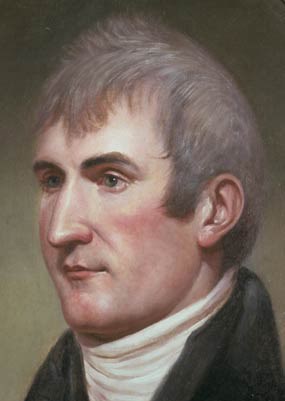
Was Meriwether Lewis murdered?
Most of us have heard about the Lewis and Clark expedition.
Meriwether Lewis was a close friend of President Thomas Jefferson, who had
ordered the expedition. On September 3, 1809, Lewis set out for Washington,
D.C. to resolve a number of issues regarding his denied payments of drafts he
had drawn against the War Department while serving as governor of the Upper
Louisiana Territory. If the payments were granted, he face bankruptcy. Lewis
was not in good mental health at this point in his life. He was depressed and
had written his will before his journey and also attempted suicide but was
restrained.
Lewis stopped at an inn on the Natchez Trace, a very dangerous
and lawless place, called Grinder's Stand. After dinner, he retired to his
one-room cabin. In the innkeeper's wife, a lowly character named Priscilla
Grinder, said she heard gunshots. Servants rushed to Lewis’s cabin and found
Lewis badly injured from multiple gunshot wounds, one each to the head and gut.
He died shortly after sunrise from loss of blood. Money that Lewis had borrowed
from a friend, Major Gilbert Russell, at Fort Pickering to complete the journey
was missing.
Historians generally agree that the account of the events
attributed to Priscilla Grinder are fabricated.. Grinder claimed Lewis acted
strangely the night before his death: standing and pacing during dinner and
talking to himself in the way one would speak to a lawyer, with face flushed as
if it had come on him in a fit. She continued to hear him talking to himself
after he retired, and then at some point in the night, she heard multiple
gunshots, a scuffle, and someone calling for help.
She claimed to be able to see Lewis through the slit in the door
crawling back to his room. However, she never explained why she never
investigated further at the time, but only the next morning sent her children
to look for Lewis's servants.
She also claimed that three men followed Lewis up the Natchez
Trace, and he pulled his pistols on them after they came to his cabin that
night. Grinder said, in this account, that she heard voices and gunfire in
Lewis's cabin about 1:00 am. She found the cabin empty and a large amount of
gunpowder on the floor. Thus, in this account, Lewis's body was found outside
the cabin.
Lewis's relatives and contended it was murder. (When William
Clark and Thomas Jefferson were informed of Lewis's death, both accepted the
conclusion of suicide) A coroner's jury held an inquest immediately after
Lewis's death as provided by the local government but proved fruitless.
There are some factors that may support Lewis's suicide
including big debts, heavy drinking, possible morphine and opium use, failure
to prepare the expedition's journals for publication, repeated failure to find
a wife, and the deterioration of his friendship with Thomas Jefferson.
Some 40 years later, in 1848, the Tennessee State Commission
decided to erect a monument Lewis’s grave. Dr. Samuel B. Moore ordered Lewis's
grave to be opened and reported that “it (The death) seems to be more probable
that he died by the hands of an assassin."
Interesting....
William Pelham Barr is an impressive guy. He served as the 77th
and 85th United States Attorney General in the administrations of Presidents
George H. W. Bush and Donald Trump. From 1973 to 1977, Barr was employed by the
Central Intelligence Agency. Barr’s father, Donald Barr, was also an
impressive guy. He taught English literature at Columbia University before
becoming headmaster of the Dalton School in Manhattan and later the Hackley
School in Tarrytown, New York, both members of the Ivy Preparatory School
League. Barr was Jewish and raised in Judaism. He served in the OSS (Which
later became the CIA) and earned an MA from Columbia.
He was headmaster of the Dalton School from 1964 to 1974. During
his time as Dalton's headmaster, Barr is alleged to have had a role in hiring
future financier and convicted sex offender Jeffrey Epstein as a math teacher
despite the fact that Epstein (who graduated from high school at the age of 16
and secured a full scholarship to Cooper Union) had failed to complete his
degree and was only 21 years old at the time. In 1973, Barr published Space
Relations, a science fiction novel about a planet ruled by oligarchs who engage
in child sex slavery. The novel’s plot anticipates the crimes of Epstein and
his alleged accomplice, Ghislaine Maxwell.
Literary suicide
Robert E. Howard dreamed of becoming an adventure writer since
he was a child. At age 23, his dream came true. He created the character Conan
the Barbarian. One of the best-selling fantasy writers of all time, his works
are still reprinted to this day.
In June 1936, Howard’s mother was gravely ill and had slipped
into her final coma. Howard, who had been sitting vigil at her bedside, left
the hospital and, while sitting in his car in the parking lot, shot himself in
the head. While his wounds were grave, he did hold on for another eight hours
before he passed away. His final words read, “All fled, all done, so lift me on
the pyre, the feast is over and the lamps expire.”
Hunter S. Thompson was the founder of the gonzo
journalism movement. Thompson grappled with depression for most of his life,
his then-recent hip replacement and broken leg caused him weeks of pain and
immobility. On February 20, 2005, while on the phone with his wife Anita, Thompson
shot himself to death. He left a note entitled “Football Season Is Over” which
read, “No More Games. No More Bombs. No More Walking. No More Fun. No More
Swimming. 67. That is 17 years past 50. 17 more than I needed or wanted.
Boring. I am always bitchy. No Fun – for anybody. 67. You are getting Greedy.
Act your old age. Relax – This won't hurt.”
Charlotte Perkins Gilman was a utopian feminist born in 1860. A
humanist, she spread her beliefs through her novels, short stories, poetry, and
as a lecturer for social reform.
In January 1932, Gilman received the news that she had been
diagnosed with incurable breast cancer. As an advocate of euthanasia, it was
her firm belief that people should be allowed to die in peace without
suffering. On August 17, 1935, she committed suicide by overdosing on
chloroform, leaving behind her final words, “When all the usefulness is over,
when one is assured of an unavoidable and imminent death, it is the simplest of
human rights to choose a quick and easy death in place of a slow and horrible
one.”
Nicholas-Sebastian Chamfort was a French writer best known for
his epigrams, aphorisms, and stimulating conversation. He became a radicalized
Republican during the French Revolution and his criticisms eventually landing
him in prison.
After his release, he was threatened with additional jail time
which he could not tolerate. Instead of facing a court, Chamfort shot himself
in the face. His suicide note read, “I, Sebastien-Roch Nicolas de Chamfort,
hereby declare my wish to die a free man rather than to continue to live as a
slave in a prison."
Poet Sara Teasdale released four collections of poetry, one of which earned her a Pulitzer Prize. Although she and Vachel Lindsay were in love, she married Ernst Filsinger who left her feeling lonely as he was away from home the majority of the time. Two years after Lindsay’s suicide of Lindsay, Teasdale also took her life by overdosing on sleeping pills. Her suicide note entitled I Shall Not Care read, “When I am dead and over me bright April Shakes out her rain-drenched hair, Tho' you should lean above me broken-hearted, I shall not care. I shall have peace, as leafy trees are peaceful, When rain bends down the bough, And I shall be more silent and cold-hearted Than you are now.”
Art for the Blog of It: The iconic promotional image of Willem Dafoe.
The Assassin Richard Lawrence
Richard
Lawrence was born in England in or about 1800 and arrived in the US when he 12
or 13 years old. His father died in the District of Columbia, in the old Ward
One sector, in or about 1829.
Lawrence,
a handsome young man, was known to be sober, well spoke but shy and reserved
and by 1832, according to his family, seemed be losing his sanity. He lived
with his sister and brother-in-law for a while but after an attempt to murder
his sister for no known reason, he was arrested and later moved to a boarding
house.
Since
he made his living as a house painter, there is considerable speculation on the
possibility that exposure to the chemicals in the paint had affected Lawrence’s
mind.
On
January 30, 1835, a cold, rainy and generally miserable day Lawrence was seen
in his paint shop in Georgetown (then a part of Maryland) on the corner of
Pennsylvania and 21st Street, having a very loud argument with himself which
ended when he screamed “All right, I’ll be damned if I don’t do it”
A
few hours later went up to the Capitol building to murder President Andrew
Jackson while he attended to the wake of Rep. Warren Davis of South Carolina at
a State Funeral Service at the Capitol.
As
the frail President, leaning on his walking stick, enter the building, Lawrence
leaped out from behind a pillar near the East Portico, brandished two
single-shot brass pistols that had belonged to his father.
Lawrence
leaped out from behind the pillar and standing less than five feet from the
President fired his pistol, but it misfired. President Jackson, with Treasury
Secretary Taney on his left, had been expecting an attempt on his life, cussed
Lawrence, raised his cane and charged the assassin thrashing him.
Lawrence
stepped back, fired the other pistol, but that too misfired. (US Marshal’s
tested the pistols he used and retested them and each time they performed
flawlessly. A New York Times article calculated the chances of both of
Lawrence’s pistols misfiring to be 1 in about 125,000.) A navy Lieutenant named
Gedney, who was with Jackson, leaped on Lawrence, wrestled him to the ground
and pulled the two pistols out of his hand.
Richard
Lawrence’s act was the first instance of a President of the United States being
the target of an assassination. A few years before, Jackson had become the only
president to be physically assaulted.
On
May 6, 1833, Jackson, age 66, ill and frail, sailed on USS Cygnet to
Fredericksburg, Virginia, where he was to lay the cornerstone on a monument
near the grave of Mary Ball Washington, George Washington's mother.
(Jackson
was rarely in good health to begin with. During his life he suffered from
smallpox,
osteomyelitis, malaria, dysentery, rheumatism, dropsy, “cholera morbus”
(widespread intestinal inflammation), amyloidosis (a waxy degeneration of body
tissues) and bronchiectasis (inflamed and dilated bronchial tubes). He also had
a
bullet
lodged inside his lungs from a duel.)
Jackson
had fired Navy lieutenant, Robert Randolph for embezzlement. During a stopover
near Alexandria, Jackson decided to entertain visitors to the boat and
Randolph, walked aboard, said nothing, walked up to President, removed his
gloves and punched him in the face. (Some say that Randolph punched the
President, some say he slapped him and other say he tweaked the President’s
nose)
Jackson,
who had been reading a book, fell back and was trapped in his chair behind the
table as Randolph was quickly held back by some of Jackson’s associates and
some of Randolph’s own friends who had boarded the steamboat with Randolph.
Jackson
angrily yelled, “What, Sir! What, Sir!”, as he scrambled to get out of his seat
and lunged for his cane. Rather than face an angry Jackson man to man, Randolph
broke lose and fled only to be run down and captured by Jacksons staff and
friends including the writer Washington Irving.
Jackson
was not seriously hurt but he was furious and embarrassed. “Had I been apprised
that Randolph stood before me” he said “I should have been prepared for him,
and I could have defended myself. No villain has ever escaped me before; and he
would not, had it not been for my confined situation.”
Jackson
declined to press charges, but Randolph was arrested anyway. By the time
Randolph went to trial for attacking Jackson, the President was retired to his
estate in
Tennessee.
In a letter to the new President Martin Van Buren, Jackson said, “I have to
this old age complied with my mother’s advice to ‘indict no man for assault and
battery or sue him for slander’, and to fine or imprison Randolph would be no
gratification." Jackson asked President Van Buren to pardon Randolph if
his assailant was found guilty for the attack.
Back
in Washington in 1836, during questioning, it quickly became clear that the
shooter Richard Lawrence was a babbling lunatic who offered no less than six
reasons to explain the shooting including his belief that he was the secret king
of England, Richard III who died in 1485 and that Jackson was his clerk. In
fact, on his first day in court, where he was defended by Francis Scott Key,
Lawrence, impeccably dressed and well spoken, rose and addressed the court with
great dignity and said "I am under the protection of my father at home.
The throne of Great Britain and the throne of this country of right belong to
me. I am superior to this tribunal. I ask you to consider whether you are safe
in your course of proceedings.” The judge respectfully reminded Lawrence that
he would be heard through his Counsel, and politely requested him to take his
seat.
When
the Jurors were called in and sworn on the bible, Lawrence rose again and
shouted "Swear on that book, but remember that I am King of England and of
this country, and will most assuredly punish you"
When
the court ordered Lawrence to sit and be silent he said, "I will not"
and remained standing until a federal marshal sat him down and stood by his
chair for the rest of the trial.
A
half a dozen doctors testified that they believed that Lawrence was insane; and
that he was unable to discriminate between right and wrong in a case connected
with his delusion; and that if the act of assaulting the President was
connected with the subject of his delusion, he was not to be considered as
morally accountable for the act. Lawrence was institutionalized at what would
become St. Elizabeth’s hospital (He was the institution's seventh inmate) until
his death in 1861.
Jackson
suspected that a circle of his political enemies orchestrated the attempt on
his life, but his suspicions were never proven. His primary suspect was his
decades-long enemy Henry Clay and Senator John C. Calhoun. Jackson told aides
that he suspected both were involved in his potential assassination and had
likely hired or convinced Lawrence to pull the trigger. Speculation grew so
severe that Calhoun made a statement on the Senate floor that he was not
connected to the attack. Jackson also suspected Senator George Poindexter of
Mississippi, (Below) who had used Lawrence to do some house painting a few
months earlier. There were several reports, by reliable witnesses, that on the
morning of the failed assassination, that Lawrence had been to Poindexter’s
house. Poindexter denied the charges but was soundly defeated for re-election
anyway.
(Foot
note on Poindexter’s interesting private life. In 1804 Poindexter married Lydia
Carter the daughter of a prominent Natchez businessman and plantation owner.
The couple had two sons , George and Albert but Poindexter publicly accused his
wife of infidelity and claimed that their second child, Albert, was the product
of an extramarital affair between his wife and their neighbor. In 1816
Poindexter married Agatha Ball Chinn, part of an old and distinguished southern
family, but had a life-long liaison with a slave woman who worked on his
plantation.)
Cheating death
On December 13, 1977, the University of Evansville team boarded a plane at the Evansville
Airport along with head coach Bobby Watson, members of his staff, a radio broadcaster and
some fans. They were on their way to Tennessee for a game against Middle Tennessee State.
The plane crashed into a hillside not long after takeoff. All
29 people on board were killed.
The only member of the Evansville team who was not on the plane
that night was David Furr, an ankle injury kept him home. Two weeks after the
crash he was killed in a car accident.
Dollar rumors
DOLLAR BILLS PRINTED IN DALLAS BEAR A "K" SIGNIFYING OR PREDICTING KENNEDY'S DEATH!!!!!!
Well no.
The inter loons have come up with a theory that states that the
Federal Reserve symbol of bills printed in Dallas, they all have the letter
"K" in them as in Kennedy, who was shot in Dallas. Each corner shows
the number 11, the month he died. Even bills printed before 1963 also have the
same lettering.
The reality is that the Dallas Reserve is the headquarters of
the 11th Federal Reserve District and has been since 1911 (three years before
Kennedy was born). "K" is the 11th letter of the alphabet.
Michael Clark Rockefeller, one of the wealthiest men in the world disappeared
Michael Clark Rockefeller, one of the wealthiest men in the
world and the fifth child of New York Governor and future U.S. Vice President
Nelson Rockefeller, disappeared on or about November 19, 1961, during an
expedition in the Asmat region of southwestern Netherlands New Guinea (Now a
part of the Indonesian province of Papua.)
Michael was a little bit different from the other Rockefellers.
Although he attended The Buckley School, Phillips Exeter Academy, and Harvard
(Cum Laude) He served six months as a private in the U.S. Army and held a
series of low level, low paying teaching positions.
He volunteered for an expedition for Harvard's Peabody Museum of
Archaeology and Ethnology to study the Dani tribe of western Netherlands New
Guinea. On November 17, 1961, Rockefeller and Dutch anthropologist René Wassing
were in a 40-foot) dugout canoe about 3 miles from shore when their double
pontoon boat was swamped and overturned.
Their two local guides swam for help, but it was slow in coming.
After drifting for some time, early on November 19 Rockefeller said to Wassing
"I think I can make it" and swam for shore. The boat was an estimated
12 miles from the shore and its probable that Rockefeller died from exposure,
shark attack, or saltwater crocodile, exhaustion, and/or drowning.
There is also the probability that since the area was filled
with headhunting and cannibalistic tribes, that he may have been murdered as
well.
In 1969, the journalist Milt Machlin investigated Rockefeller's
disappearance and concluded that circumstantial evidence supported the idea
that he had been killed by the locals in or near the village of Otsjanep where
he likely would have arrived had he made it to shore. In 1958, several
villagers had been murdered by a Dutch patrol, providing some rationale for
revenge by the tribe against a white man.
There is a persistent story and testimony that men from Otsjanep
killed Rockefeller after he swam to shore. The tribesmen killed and ate him by
the shore. Soon afterward the villages were swept by a cholera epidemic and
the villagers believed that it was retribution for killing Rockefeller.
In 2011, Agamemnon Films released a documentary stating that
Rockefeller survived and was living among the locals.
Writer Paul Toohey claimed that in 1979, Rockefeller's mother
hired a private investigator to go to New Guinea and try to resolve the mystery
of his disappearance. She also may have offered a $250,000 reward to the
investigator that gave her proof positive that her son was alive or dead.
Whatever happened, after he left the boat, he was never seen
again. His body was never found. He was declared legally dead in 1964.No
remains or other physical proof of his death have been discovered.
Lewis Carroll as Jack the Ripper
Author and Lewis Carroll scholar Richard Wallace put out a book
called Jack the Ripper’s Light-Hearted Friend that proposes that Lewis Carroll
could have been Jack the Ripper.
Although Carroll was widely known as a gentle soul and
scholar-Mathematician, Wallace says that Carol had a nervous breakdown and as a
result developed a separate persona as Jack the ripper, Carroll’s psychotic
breakdown had come from years of abuse that he took from older boys at school
and that he took his vengeance on prostitutes.
“CROATOAN” that was carved into a tree stump on Roanoke Island (In North Carolina and not Virginia ) is the mystery of the lost colony in 1590.
Well it is and it
isn’t.
John White, the colony’s
governor had returned to England in 1587 for badly needed supplies, returning
to the oddly empty fort on August 18, 1590. England’s war with Spain delayed
his return. Among the missing was his granddaughter, Virginia Dare, the first
(documented) European born in North America.
White reported in his
diary that the word in "fayre Capital letters was graven" on one of
the palisades that had been used to build the colonist's fort on Roanoke Island,
not on a tree.
Earlier in the day's
search, White had seen the three Roman letters " CRO" carved into a
tree on the bluff of the sound shore. In neither place did the colonist
returning from England discover a cross, the secretly agreed upon a sign that the
colony, now known as the Lost Colony, was in distress.
White said he took
comfort in the fact that since no cross had been found that the entire colony,
which number about 120 persons, had come across hard times and relocated to
Croatoan, the principal town of the Croatoan (or Hatteras) Indians near Cape
Hatteras and had left the word Croatoan on the fort as had been agreed before
White left for England.
White knew that the
colonists had discussed leaving that sort of simple message for him when he
left for England in 1587, although they had then considered moving 50 miles
into the mainland rather than about 60 miles south to an isolated barrier
island.
Croatoan, White knew,
was the home of an Indian named Manteo, who made two trips to England in the
1580s and seemingly had embraced the English colonial efforts. Manteo's mother
was probably a tribal monarch of the Croatoans.
Or maybe the colonist
hadn’t left the message at all, something that needs to be considered.
Ethnologists and anthropologists believe that the word "Croatoan" may
have been a combination of two Algonquian words meaning "talk town"
or "council town." It is also likely that the colonist simply moved
their fort to another location on the island, but that location, like the
location of the original fort, is now underwater.
White was forced to return
to England, by rough seas and a lost ship's anchor, before he could mount a
search party. A later investigation by the English government concluded that
the colony had been massacred by Indians, but there is no hard evidence to
confirm that story. Further, when White arrived, there was no sign of battle or
withdrawal under duress, although the site was fortified with valuable weapons.
There were no human remains or graves in the area, suggesting that everyone was
alive when they left.
It’s possible that the
colonist tried to return to Virginia, an arduous trip in 1587, and became lost
and gave up, either being killed by hostile tribes or married into local
tribes. Modern research has still not produced the archaeological evidence to
solve the mystery.
John White later
retired to his home in County Cork in Ireland, never giving up hope that his
daughter and granddaughter were somehow still alive in the New World.
at his mother was still alive and locked up in a lunatic
asylum
Words to use and where they came from.
Abrasive means, literally,
"causing damage or wear by rubbing, grinding, or scraping."
Figuratively, it is used to describe people or things that are unpleasant or
irritating. Once upon a time, English had abrade and abrase. While abrade
remains a familiar word, abrase is rare but survives in abrasive. Both verbs
come from abrādere, meaning "to remove by rubbing" or "to scrape
off."
Sour grapes noun: Finding fault with or expressing disdain for something one cannot have. From the Aesop’s fable The Fox and the Grapes, in which a hungry fox tries to reach grapes hanging on a high vine and when unsuccessful, declares that the grapes are probably sour. Earliest documented use: 1760.
A dissatisfied customer
Mr. Goumas
Your diatribe on Amazon has promoted my book. Thank you. (“For whatever reason, people continue to be fascinated by our family tragedies”)
And thank you for buying my book, as well.
The novel clearly state’s “This is a work of
fiction”….that means “not real”, or “made up”. Did you read the book? (By the
way, you wrote “This author focuses on Ansonia, a small industrial town in
Connecticut's Lower Naugatuck Valley”…..you should have written “The author’
not “This author” and I have a name, it's in big bold letters on the book cover,
but anyway) the book isn’t about the Valley. The book is a collection of
stories about the human condition that happens in a dinner, over the course of a
day.
And why, oh why, would I engage you before writing
a piece of fiction? (“Authors don't have the courtesy to engage with us before
writing and publishing”) …and don’t use the word “Engage” when you mean “contact”.
Keep it simple and say what you mean, that’s the basis of good writing.
In your demand for privacy, you did two things
I would never do, you gave people your family name and where they lived. Now,
literally, for decades to come, the world will associate a simple faction story
with your family. Nice work.
I knew your father, your mother, your grandmother,
your brother Rocky and went to school with one of your sisters, who was beautiful
and extremely intelligent. I saw your parents several times a week at their
store, which was down the hill from us. Your parents were kind, generous, and
considerate people. I admired Rocky’s talents on the football field.
You and
I have several mutual acquaintances. I’m easily reachable. If what I write disturbs
you, why didn’t you simply contact me ……or as you so badly put it, “Engage me”,
and talk to me? After all, it's your demand that I “engage” you before writing.
What’s that saying? “Rules for ye but not for
me”
(From Amazon)
While this book was published in 2011, I was
only recently made aware of its existence. This author focuses on Ansonia, a
small industrial town in Connecticut's Lower Naugatuck Valley. In particular, I
found the author's story "Small Town Tragedy" in this collection
deeply troubling. It's a thinly-veiled telling of two real-life tragedies
experienced by my family in the late 60's-early 1970.
The portrayals of my
late father and brother are both unflattering and frankly wrong. My sister's
accidental death does not need to be relived yet again. For whatever reason,
people continue to be fascinated by our family tragedies, which is deeply
troubling to the surviving members, and authors don't
have the courtesy to engage with us before writing and publishing. I'm only
grateful that both of my parents didn't encounter this book before they passed
away.
Mark Goumas
Words to put into use
When rankle was first used in
English, it meant "to fester," and that meaning is related to French
words referring to a sore and tracing to Latin dracunculus. The Latin is from
draco, the word for a serpent and the source of English's dragon. The
transition from serpents to sores is apparently from people associating the
appearance of certain ulcers or tumors to small serpents.
Palisade comes from Latin palus, meaning "stake." The word originally applied to one of a series of stakes set in a row to form an enclosure or fortification. In time, its meaning was extended to a fence of stakes and, by association, to stretches of steep cliffs bordering a river.