
Welcome

John William Tuohy lives in Washington DC


Word stuff: Factotum
fak-TOH-tuhm
A servant or a low-level
employee tasked with many things.
From Latin factotum, from
facere (to do) + totus (all). Earliest documented use: 1573.

Advise for writers: simplify
The ability to simplify means
to eliminate the unnecessary so that the necessary may speak. -Hans Hofmann,
painter (1880-1966)


Word stuff: kamikaze
kah-mi-KAH-zee
Someone who behaves in a
reckless, self-destructive manner.
From Japanese kamikaze (divine
wind), from kami (god, divinity) + kaze (wind). Earliest documented use: 1896.
In Japanese folklore, kamikaze
was the divine wind that destroyed a Mongol invasion fleet under Kublai Khan.
In World War II, the kamikaze were suicidal attacks by Japanese pilots who
crashed their planes on an enemy target such as a ship.

Word stuff: Tycoon
ty-KOON
A wealthy and powerful person,
especially in business or politics.
From Japanese taikun (great
lord or prince), from Chinese ta (great) + kiun (prince). Earliest documented
use: 1857.

It is as easy to dream a book
It is as easy to dream a book
as it is hard to write one. -Honore de Balzac, novelist (1799-1850)

Word Stff: interlocutors
(in-tuhr-LOK-yuh-tuhr, -yoo-)
One who takes part in a
conversation or dialogue, especially as a representative of an organization.
From Latin inter- (between) +
loqui (to speak). Earliest documented use: 1518.

Word stuff: Itinerant
eye-TIN-uh-runt\
traveling from place to place;
especially : covering a circuit
In Latin, "iter" means
"way" or "journey." That root was the parent of the Late
Latin verb "itinerari," meaning "to journey." It was that
verb which ultimately gave rise to today's English word for traveling types:
"itinerant." The linguistic grandsire, "iter," also
contributed to the development of other words in our vocabulary, including
"itinerary" ("the route of a journey" and "the plan
made for a journey") and "errant" ("traveling or given to
traveling").

Word stuff: confrere
KON-frayr
Colleague; a fellow member of a
profession, fraternity, etc.
From Latin con- (with) + frater
(brother). Other cousins of this word, derived from the same Indo-European root
bhrater- (brother), are brother, pal, fraternal, and bully. Earliest documented
use: 1425.

Word stuff: Respite
RESS-pit
a period of temporary delay, an interval of rest or relief
"Respite" traces from the Latin term
"respectus," which comes from a verb meaning, both literally and
figuratively, "to turn around to look at" or "to regard."
By the 14th century, we had granted "respite" the sense we use most
often today—"a welcome break."

Word Stuff: Protege
PRO-tuh-zhay, pro-tuh-ZHAY
One who is protected, guided,
and supported by somebody older and more experienced.
From French protégé, past
participle of protéger (to protect), from Latin protegere, from pro- + tegere
(cover). Ultimately from Indo-European root (s)teg- (to cover), which is the
ancestor of other words such as tile, thatch, protect, detect, and toga.
Earliest documented use: 1786.

Word Stuff: Metonymy

Metonymy
muh-TAH-nuh-mee
a figure of speech consisting
of the use of the name of one thing for that of another of which it is an
attribute or with which it is associated
Metonymy derived via Latin from
Greek "metonymia" (from "meta-," meaning "among, with,
or after," and "onyma," meaning "name"), metonymy
often appears in news articles and headlines, as when journalists use the term
"crown" to refer to a king or queen.


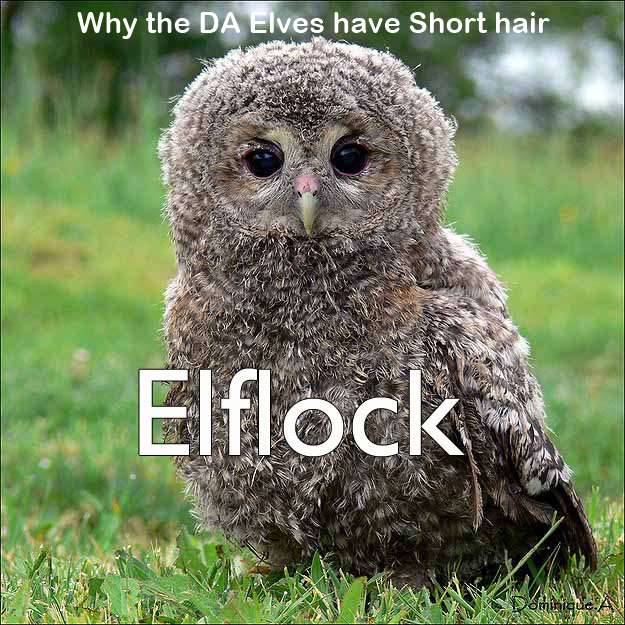
Words you’ll probably never use: Elflock

PRONUNCIATION: (ELF-lok)
MEANING:noun: A tangled lock of hair.
miscible \MISS-uh-bul\
Capable of being
mixed; specifically : capable of mixing in any ratio without separation of two
phases

"Miscible"
isn't simply a lesser-known synonym of "mixable"—it's also a cousin.
It comes to us from the Medieval Latin adjective "miscibilis," which
has the same meaning as "miscible" and which derives in turn from
Latin "miscēre," meaning "to mix." "Miscēre" is
also the ultimate source of our "mix"; its past participle
"mixtus" (meaning "mixed") spawned "mixte" in
Anglo-French and Middle English, and "mix" came about as a
back-formation of "mixte." The suffix "-able" gives us
"mixable," thereby completing its link to "miscible."
"Miscible" turns up most frequently in scientific discussions where
it is used especially to describe fluids that don't separate when they are
combined.
Quaternary

PRONUNCIATION: (KWOT-uhr-ner-ee, kwuh-TUHR-nuh-ree)
MEANING: 1. Of the fourth order.2. Consisting of or arranged
in fours.
ETYMOLOGY: From Latin quattuor (four). Earliest documented
use: 1450.
USAGE: "The patient referral system started at the
primary, to secondary, to tertiary, and finally to the quaternary level of
health care." Jane Kanchense; Zimbabwe's Child Brides; Trafford; 2011.
Depone
\dih-POHN\to assert under oath: testify

"I, Maureen
Watt, depone aat I wull be leal and bear ae full alleadgance tae Her Majesty
Queen Elizabeth," swore the newly-elected Member of the Scottish
Parliament in the dialect of the North-East of Scotland. (Translation: "I
swear that I will be loyal and bear full allegiance to Her Majesty Queen
Elizabeth.")
"Depone," a word used in Scots law for
"testify" since the 15th century, is perfectly at home in the oath.
The word originated from Latin "deponere," meaning "to put
down."
The related English verb "depose," referring to
testimony, entered the language through the same root the following century.
Though used less frequently in American English than "depose,"
"depone" is no stranger to the American court system.
Anatopism

PRONUNCIATION:(uh-NAT-uh-piz-ehm)
MEANING:The error of placing something out of its proper
place; also something placed erroneously.
ETYMOLOGY:From Greek ana- (against) + topos (place).
Anatopism is to place what anachronism is to time. Earliest documented use:
1812.
Snowbroth

PRONUNCIATION: (SNO-broth)
MEANING: Melted snow.
ETYMOLOGY: From Old English snaw (snow) + broth (broth).
Earliest documented use: 1600.
Tourbillion

Tourbillion \toor-BIL-yun\Meaning a whirlwind, a vortex especially of a whirlwind or
whirlpool
"Tourbillion" (which can also be spelled
"tourbillon" and pronounced "toor-bee-YAWNG") comes from
the same root as "turbine"—namely, the Latin word "turbo,"
meaning "top" (as in a spinning object) or "whirlwind."
"Tourbillion" has been used over time to refer to other spinning
objects besides an actual whirlwind. Among watchmaking enthusiasts,
"tourbillion" is the name of a kind of watch with a mechanism
designed to compensate for the effects of gravity on its movement. Among
pyrotechnics fans, a tourbillion is a kind of firework having a spiral flight.
Orgulous

Orgulous \OR-gyuh-lus\Meaning proud, haughty
"In
Troy, there lies the scene. From Isles of Greece
The princes orgulous, their high blood chaf'd,
Have
to the port of Athens sent their ships."
Thus Shakespeare
began the Trojan War tale Troilus and Cressida, employing "orgulous,"
a colorful word first adopted in the 13th century from Anglo-French
"orguillus." After the Bard's day, "orgulous" dropped from
sight for 200 years; there is no record of its use until it was rejuvenated by
the pens of Robert Southey and Sir Walter Scott in the early 1800s.
Twentieth-century authors (including James Joyce and W.H. Auden) continued its
renaissance, and it remains an elegant (if infrequent) choice for today's writers.
Potemkin Village

MEANING: An
impressive showy facade designed to mask undesirable facts.
ETYMOLOGY: After Prince Grigory Potemkin, who erected
cardboard villages to fool Empress Catherine II during her visit to Ukraine and
Crimea in 1787. Earliest documented use: 1904.
Subscribe to:
Posts (Atom)